Let’s make it work for you
Building AI Agents with Python - Blended Learning

- Categories:
- Artificial Intelligence
- Level:
- Expert
- Tier type:
- Essentials
- Code:
- QAAIAGPY-BL
- Exam:
- Not Applicable
Overview
Blended Learning – the best of both ways to learn.
This course blends the flexibility of self-paced learning with the structure of live, instructor-led sessions. You'll learn from world-class industry experts and gain practical skills to drive meaningful results in your workplace. Our digital platform also empowers you to track your progress and manage your learning journey effectively.
Prerequisites
Participants should have:
- Experience with base Python including collections and experience with common packages for data handling such as NumPy or Pandas.
- If participants do not yet have the expected prior knowledge this can be gained through QADHPYTHON Data Handling with Python
- Desirable experience with Machine Learning development processes
- If participants do not yet have this prior knowledge this can be gained through either QAIDSDP Introduction to Data Science for Data Professionals or QADSMLP Data Science and Machine Learning with Python
Target Audience
This course is designed for:
- Data Scientists
- Software Developers
- Machine Learning Engineers
- AI Engineers
- DevOps Engineers
What's included
Select your preferred way to learn:
What is Blended?
A mix of digital learning and live instructor-led sessions
A structured programme combining self-paced digital content with scheduled live virtual sessions. Learners build knowledge at their own pace, then apply it with expert support in interactive sessions.
Best for: Individuals and teams who benefit from flexibility alongside guided learning and collaboration.
What's included?
1 hour self-paced learning
3 days instructor led course
Exam: Not Applicable
6 month free access to QA learning platform
Self-Paced Learning
- Up to 1 hour, completed over a 4-week period prior to the live event.
- It is recommended that the self-paced learning is completed prior to joining the live event.
- It is recommended that learners have a minimum of 4 weeks between the course booking and the instructor-led live event to complete the necessary hours of learning.
- The self-paced learning is available 4 weeks prior to the live event and for 12 months following the live event.
Instructor-Led Live Event
- This course has a 3-day live event.
Free 6-Month Access: Learning Platform Discovery plan
Included FREE with every instructor‑led course
Get free guided access to the QA Learning Platform. Assess your skills, explore in-demand topics, and understand which areas to focus on.

Learn AI, Cloud, Data, and Leadership skills at your own pace.

Put skills into practice with hands-on Labs and Simulabs.

Validate knowledge and highlight gaps with skills assessments.
What is bespoke training?
Custom instructor-led training designed by QA to fit your needs
Tailored programmes built around your organisation’s goals, challenges, and skill levels. Delivered in the format that suits you to maximise relevance and impact.
Best for: Organisations and teams looking to target specific business priorities and capabilities with QA subject matter expertise.
Find out more about the course:
Outline
01 The World of Agents
- Define AI agents and their components in a modern context
- Describe how agents can solve organisational problems
- Outline the current tech stack used to build agents
- Build your first AI agent with a low-code solution
- Discuss real-world agentic AI use cases
02 A Practical Introduction to Language Models
- Define what a language model is
- Describe the evolution of language models
- Distinguish between different types of language models based on architecture, scale, and modality
- Interact with a language model via a hands-on demo
- Reflect on how prompt design affects model outputs
03 Working with Multiple Agents
- Design a multi-agent system using LangGraph for agent orchestration
- Plan the roles and interactions among multiple agents for a collaborative task
- Apply coordination features for agent communication and task delegation
- Discuss the strengths, limitations, and potential issues of multi-agent systems
- Explore other frameworks for building multi-agent systems (AutoGen and CrewAI)
04 Equipping Agents with Tools
- Discuss what actions and tools are in the context of AI agents
- Learn how to define and customize your own tools
- Explore how to connect tools to agents and enable action-taking
- Handle tool errors and execution limits
- Try out pre-built tools for rapid prototyping
05 Building AI Agents for Good: Ethics, Risk, and Responsibility
- Explain why governance is essential in agentic AI systems and what can go wrong without it
- Identify the core ethical principles that should guide AI agent behavior
- Recognize key risks at the agent level and governance strategies
- Discuss what programmatic guardrails are and how they help enforce responsible behavior in AI agents
- Evaluate real-world use cases of agentic systems and debate the ethical, legal, and practical implications from different perspectives
- Connect global AI governance frameworks to the practical design of agentic systems
06 Improving Agentic Systems with RAG and Prompt Engineering
- Discuss why prompt structure and content is important and develop effective prompts to improve agentic responses
- Discuss how chain of thought and tree of thought prompting can iteratively build an optimal agent response
- Implement a RAG system which is capable of grounding an agent to a knowledge base
07 Tracing, Observability, Monitoring, & Evaluation in Agentic Systems
- Discuss why tracing is important and how it helps us see what our AI agents are actually doing behind the scenes
- Use LangSmith to monitor your agents, so you can catch bugs, see how they make decisions, and understand their outputs better
- Give your agents a score by setting up ways to evaluate their answers – using human feedback or automatic checks
- Build feedback loops so your agents can keep getting better based on how users interact with them
- Try different ways to improve your prompts and test changes before making them live
- Get your agents ready for the real world by setting up alerts and making sure they’re working well for users
08 End of Course Project
- Design a complete agentic system using LLMs, tools, memory, and multi-agent coordination
- Apply ethical principles, safety checks, and tracing and evaluation strategies to an open-ended real-world task
- Integrate RAG and prompt engineering to improve relevance and performance
- Optionally, deploy a minimal frontend using Streamlit to demonstrate the system as a working prototype
Exams and assessments
Learning outcomes are assessed through activities within this Instructor-Led course.
Delivery Method
This Blended Learning course consists of two key stages.
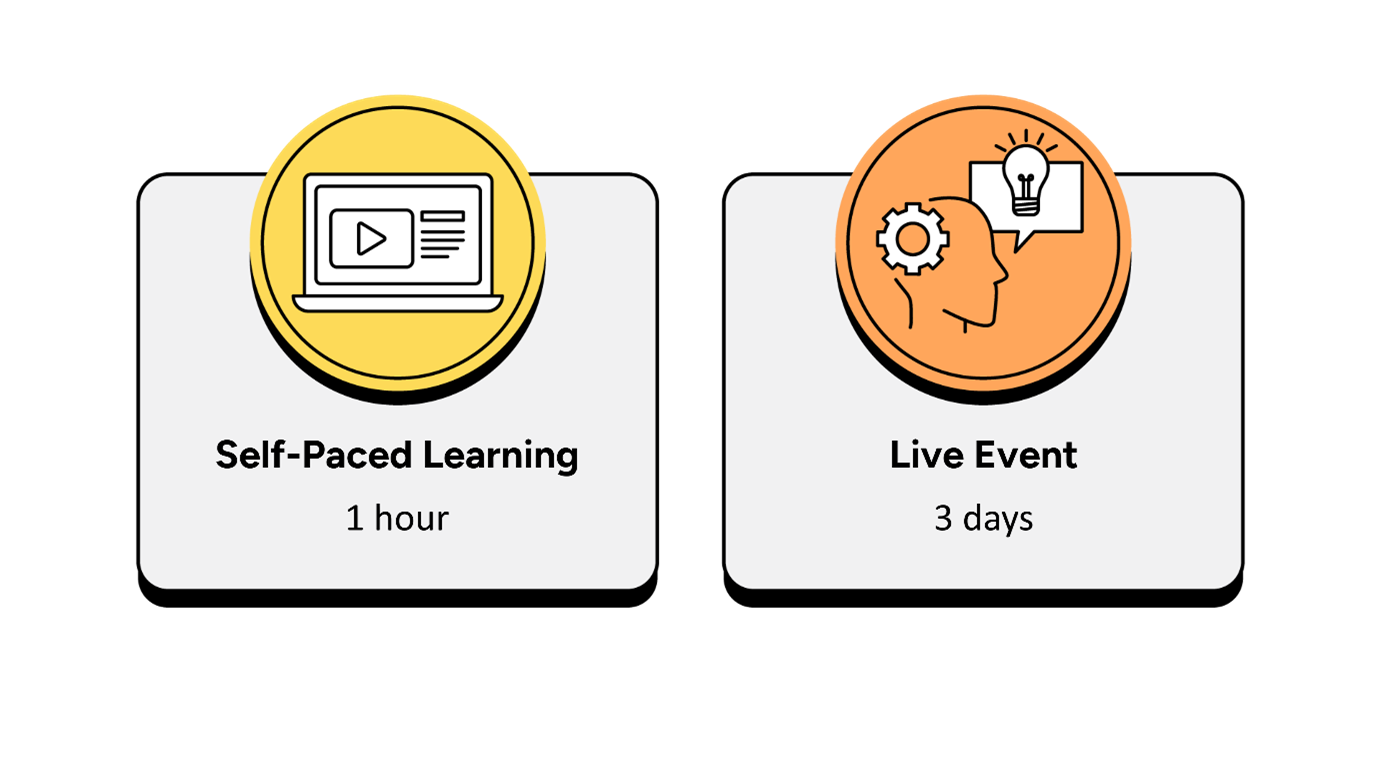
Self-Paced Learning
- Up to 1 hour, completed over a 4-week period prior to the live event.
- It is recommended that the self-paced learning is completed prior to joining the live event.
- It is recommended that learners have a minimum of 4 weeks between the course booking and the instructor-led live event to complete the necessary hours of learning.
- The self-paced learning is available 4 weeks prior to the live event and for 12 months following the live event.
Instructor-Led Live Event
- This course has a 3-day live event.
Learning outcomes
By the end of this course, learners will be able to:
- Build single AI Agent and multi-agent systems using LangGraph
- Extend multi-agent systems with integrated tools to perform real-world actions, for example, for Customer Service
- Make your agentic system safe, ethical, and responsible
- Improve agentic system performance
- Complete a project to design, build, govern, test, and evaluate a working agentic AI system with a simple front end – take your project with you to demonstrate the art of the possible within your organization
Good to know
Ready to book? Complete the form and a member of our team will be in touch shortly to discuss your options.
Let’s make it work for you. Speak to one of our learning experts today.
What our customers are saying

“As a leading Cloud Solutions Training Services Partner, QA’s Microsoft 365 Copilot Adoption Accelerator offers organisations an innovative and scalable training solution to increase user productivity, confidence, and consistent best practice use of Copilot across the business.”
Jeroen van Hilten
Global Partner Sales Executive, Microsoft Worldwide Learning

"The AI Champions Pathway was invaluable at really helping to super-charge AI adoption across Awaze... we've seen the application of AI-first thinking grow rapidly; from simple everyday ChatGPT usage for communications, to the creation of GPTs, to evolved complaints handling processes. As a business, we now see innovative, AI-first thinking as a key enabler to our strategic priorities, rather than a nice-to-have.”
Charlotte Hickey
People Transformation Lead, Awaze
“QA's training and hands-on labs are a powerful approach to maximising the value of Microsoft 365 Copilot adoption. Copilot is a once-in-a-generation technology, and using QA to learn this technology is a smart way to harness AI-driven productivity.”
Tatiana Arventi
Senior Go To Market Manager - M365 Copilot Microsoft UK
Portfolio Director
Dr Vicky Crockett
Portfolio Director – Artificial Intelligence


Frequently asked questions
How can I create an account on myQA.com?
There are a number of ways to create an account. If you are a self-funder, simply select the "Create account" option on the login page.
If you have been booked onto a course by your company, you will receive a confirmation email. From this email, select "Sign into myQA" and you will be taken to the "Create account" page. Complete all of the details and select "Create account".
If you have the booking number you can also go here and select the "I have a booking number" option. Enter the booking reference and your surname. If the details match, you will be taken to the "Create account" page from where you can enter your details and confirm your account.
Find more answers to frequently asked questions in our FAQs: Bookings & Cancellations page.
How do QA’s virtual classroom courses work?
Our virtual classroom courses allow you to access award-winning classroom training, without leaving your home or office. Our learning professionals are specially trained on how to interact with remote attendees and our remote labs ensure all participants can take part in hands-on exercises wherever they are.
We use the WebEx video conferencing platform by Cisco. Before you book, check that you meet the WebEx system requirements and run a test meeting to ensure the software is compatible with your firewall settings. If it doesn’t work, try adjusting your settings or contact your IT department about permitting the website.
How do QA’s online courses work?
QA online courses, also commonly known as distance learning courses or elearning courses, take the form of interactive software designed for individual learning, but you will also have access to full support from our subject-matter experts for the duration of your course.
Once you have purchased the Online course and have completed your registration, you will receive the necessary details to enable you to immediately access it through our e-learning platform and you can start to learn straight away, from any compatible device. Access to the online learning platform is valid for one year from the booking date.
All courses are built around case studies and presented in an engaging format, which includes storytelling elements, video, audio and humour. Every case study is supported by sample documents and a collection of Knowledge Nuggets that provide more in-depth detail on the wider processes.
When will I receive my joining instructions?
Joining instructions for QA courses are sent two weeks prior to the course start date, or immediately if the booking is confirmed within this timeframe. For course bookings made via QA but delivered by a third-party supplier, joining instructions are sent to attendees prior to the training course, but timescales vary depending on each supplier’s terms. Read more FAQs.
When will I receive my certificate?
Certificates of Achievement are issued at the end the course, either as a hard copy or via email. Read more here.